Shipping fragile items: packaging, carriers and insurance
Published on , updated on 8 min read The 123Ventes team

A bowl that arrives in three pieces means a lost piece, a second delivery to pay for and a disappointed customer. For a ceramicist, a glassmaker or a fine-food shop selling jars, breakage is the great fear of selling online. The good news: it can almost always be avoided.
Here’s how to pack, which carrier to choose, what insurance really pays out, and what to do on the day a parcel arrives broken despite everything.
Who pays when it breaks?
When you sell to a consumer in France, the answer is simple: you do. The French Consumer Code makes the seller responsible for delivery until the customer has the parcel in their hands. If the piece arrives broken, you must replace it or refund it, and it’s then up to you to claim from the carrier. A sentence in your terms of sale saying otherwise would have no legal value.
In other words, good packaging isn’t just about pleasing the customer: it protects your margin.
A carrier can refuse to pay out for breakage if it considers the packaging was inadequate. Tableware, porcelain and glass are precisely the items it looks at most closely. A well-packed parcel also means a solid claim.
Packing properly: the 7 rules
- Wrap each piece separately. Bubble wrap or kraft paper, several layers. The lid of a teapot, the cups of a set: each item travels in its own protection, never touching another.
- Fill the inside. A vase, a bowl, a carafe: slip crumpled paper inside. A hollow piece holds up much better when it’s full.
- Use the double-box method. The wrapped piece goes into a first, snug-fitting box, and that box goes into a second, larger one, with at least 5 cm of padding on all six sides. The shock stops in the padding before it reaches the piece.
- Fill every gap. Crumpled kraft paper, shredded paper, packing peanuts, air cushions: it doesn’t matter, as long as nothing moves.
- Use a new, rigid box. A reused box has already lost some of its strength. For bottles and jars, cell-divided boxes are made for the job.
- Seal with strong tape, in an H pattern: along the middle seam and along both edges, top and bottom.
- Do the test. Shake the sealed parcel: you shouldn’t hear anything move. A piece that moves is a piece that breaks.
A “Fragile” label does no harm, but don’t rely on it: parcels go through sorting machines, which can’t read. It’s the packaging that protects, not the label.
Take two photos before sealing each fragile parcel: the piece in its first box, then the padding in the second. They only take ten seconds and, if you ever need to make a claim, they prove the packaging was done properly.
Ceramics, glass, bottles: special cases
| Item | The weak point | Good practice |
|---|---|---|
| Bowl, plate, cup | Rims and handles | Bubble wrap around the handle first, then the whole piece; plates stood on their edge, separated by cardboard |
| Vase, carafe, jug | The neck and the spout | Fill the inside, protect the neck with a bubble-wrap sleeve, wedge the vase upright |
| Teapot, lidded pot | The lid moving around | Wrap the lid separately, never resting on the pot |
| Blown glass, stained glass | Impacts and bending | Double box essential; stained glass laid flat between two sheets of rigid cardboard |
| Jars, bottles | Weight and leaks | Cell-divided box, lids taped shut, each jar in a sealed bag |
For very large pieces, storage jars or full dinner services, the best solution is often not to ship at all: offer collection from the workshop or deliver them yourself locally.
Which carrier should you choose?
The more a parcel is handled, the more likely it is to be dropped. Your choice of carrier therefore depends on how fragile and how valuable the piece is (the services below are those available in France):
| Delivery method | Best for | Good to know |
|---|---|---|
| Colissimo home delivery | Fragile or valuable pieces | Tracking, signature on delivery available, extra insurance up to €1,000 |
| Pick-up point (Colissimo, Mondial Relay) | Small, sturdy pieces, small budgets | Cheaper, but more handling; low basic compensation |
| Courier (DPD…) | Heavy parcels, regular shipments in volume | Contract to negotiate, rates based on your volume |
| Your own delivery | Large pieces, nearby customers | No breakage on the way, and direct contact with the customer |
| Collection from the workshop | Anything bulky or precious | Free for the customer, who also discovers your other pieces |
Nothing forces you to pick just one method: you could, for example, offer pick-up points for small pieces, Colissimo for the rest, and workshop collection for everyone. The customer chooses at checkout.
Insurance: what you’ll actually receive
This is the nasty surprise for many makers: carriers’ basic compensation is calculated on the parcel’s weight, not on the value of what’s inside. With Colissimo (the French postal service’s parcel arm), it’s €23 per kilo, with a minimum of €5.75 and a maximum of €690. With Mondial Relay, it’s limited to a small flat amount. A piece of ceramics weighs little for what it’s worth:
| Example: a vase sold for €180 | Amount |
|---|---|
| Weight of the packed parcel | 1.2 kg |
| Basic Colissimo compensation: 1.2 × €23 | €27.60 |
| What you lose if the vase breaks, without insurance | over €150 |
| Ad valorem insurance up to €300 | €5.90 |
To cover the real value, Colissimo offers two options, only for parcels delivered against signature:
- registered delivery (“recommandation”): flat-rate compensation of €50 or €200, for a few euros;
- ad valorem insurance: the real value, up to €1,000, provided you can prove it with an invoice. In October 2026, allow €5.90 for €300, €7.90 for €500 and €12.90 for €1,000.
These rates change regularly: check them on the La Poste website when you send. For other carriers, read the compensation terms of their insurance options before relying on them.
When should you insure? As soon as the value of the piece is clearly higher than the basic compensation. For small, inexpensive pieces, many makers prefer to be their own insurer: they build a small allowance for breakage into their prices, and replace the rare broken piece without argument. To do this calculation, go back to the method for pricing your handmade products.
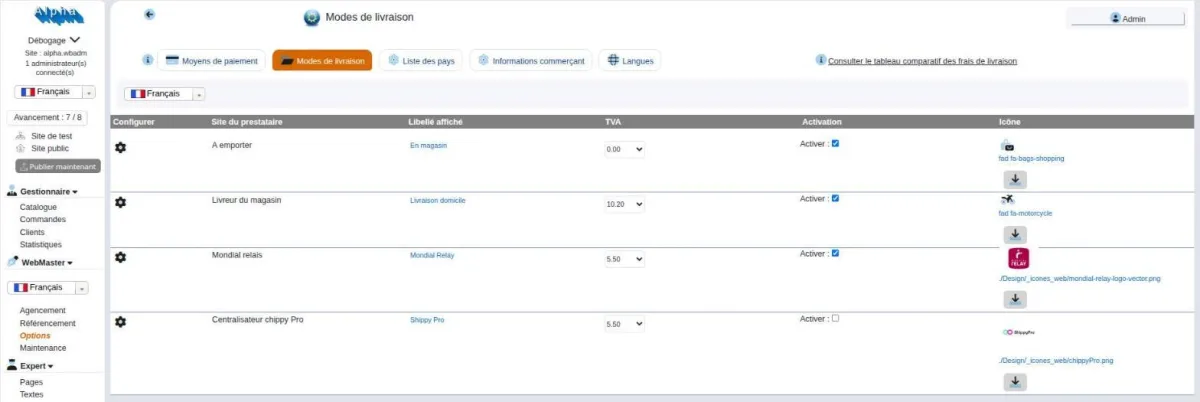
With 123Ventes, you tick your delivery methods (Colissimo, pick-up point, your own delivery, workshop collection) and shipping costs are calculated according to weight and destination. €29.90 a month, no commission.
Calculating your shipping costs correctly
A fragile parcel is heavier and bigger than you’d think: double box, padding, bubble wrap… To avoid losing money on every shipment:
- Weigh the packed piece, not the bare piece, and enter that weight on the product page. That’s the weight the carrier charges for.
- Include the cost of packaging: boxes, padding and tape can cost one to three euros per parcel. Put it into the price of the piece or into the shipping costs, but don’t forget it.
- Set up a rate table by zone and weight: France, Europe, the rest of the world, each with its own weight bands. You can also decide to ship the most fragile pieces within France only.
- Show the insurance if you charge for it: a customer who sees “tracked and insured delivery” is more willing to pay two euros extra.
The parcel arrives broken: what should you do?
- Ask the customer for photos: the sealed box, the opened box with its padding, the broken piece. Ask them to keep the packaging until the matter is settled.
- If the box is visibly damaged on delivery, the customer can refuse it or note specific reservations with the delivery driver. Remind them of this in your terms of sale.
- Replace or refund quickly, without waiting for the carrier’s reply. A customer who is treated well after a breakage comes back, and tells others.
- File a claim with the carrier with the tracking number, the photos and the invoice. The deadlines for claims are short: do it within days of delivery.
- Learn the lesson: if the same piece breaks twice, it’s the packaging or the carrier that needs to change.
Write this rule down in black and white in your terms and conditions of sale, so that everyone knows it before ordering. What they must contain is explained in selling your creations online: what the law says.
Double-box packaging, tracked Colissimo for valuable pieces, ad valorem insurance beyond what the weight-based compensation covers, and workshop collection for bulky pieces: with these four habits, breakage becomes rare.
Frequently asked questions
How do you pack ceramics to send them by post?
Wrap the piece on its own in bubble wrap, fill the inside with crumpled paper, place it in a first snug-fitting box, then in a second, larger box with at least 5 cm of padding on every side. Shake the sealed parcel: nothing should move.
Which carrier should you choose for a fragile item?
For a fragile or valuable piece, choose tracked home delivery such as Colissimo, with signature on delivery and insurance. Pick-up points are cheaper and better suited to small, sturdy pieces. For large pieces, offer workshop collection or your own delivery.
How much does Colissimo pay out for breakage?
Without any option, Colissimo pays a flat-rate compensation based on weight: €23 per kilo, between €5.75 and €690. To be refunded the real value, up to €1,000, you need ad valorem insurance, with delivery against signature and an invoice to prove the value.
Who is responsible if the parcel arrives broken?
When you sell to a consumer in France, it’s the seller: they are responsible for delivery until the customer has the parcel in their hands. You replace or refund the piece, then make the claim with the carrier yourself.
Does a “Fragile” label protect the parcel?
Very little. Parcels go through sorting machines that don’t read labels. It’s the packaging, a well-padded double box, that really protects the piece.
Conclusion
Shipping ceramics or glass doesn’t have to be a gamble: careful packaging, the right carrier and insurance that matches the piece are enough to make breakage rare. And when it does happen anyway, a quick response turns an incident into a loyal customer.
Every trade has its own particularities: see our advice for potters and ceramicists, for glassmakers and stained-glass artists, for fine-food shops and for handmade candles, and all the available carriers on the delivery methods page.
👉 Try 123Ventes for free: €29.90 a month, no commission on your sales.