Why choose a simple e-commerce solution (and how to recognise one)
Published on , updated on 6 min read The 123Ventes team

When we choose a tool to sell online, we tend to behave as we do in the kitchen appliance aisle: we take the one with the most buttons. Just in case. Then we end up with a food processor with fourteen programmes, of which we use two, and which takes twenty minutes to clean.
For a craftsperson’s or shopkeeper’s online shop, it is the same. Power comes at a price, and that price is not always written on the pricing page. Here is why simplicity is often the smartest choice, how to recognise a truly simple solution, and when it is not enough.
Complexity is expensive, even when it is free
A complicated tool does not send you an invoice for its complexity. You pay for it in other ways, in four currencies.
- Time. Every hour spent hunting for a setting, reading a tutorial or working out why the basket no longer shows the delivery charges is an hour less in the workshop or the shop. Three hours a week of “tinkering” with the website adds up to more than a hundred hours over a year. Almost three weeks of work.
- Little subscriptions. When the basic tool does not do everything, you add plug-ins: customer reviews, translation, product options. Each one seems modest. Together, they can double the starting bill, and you only notice when you go through your bank statements.
- Commissions. Some platforms take a percentage of every sale, on top of bank fees. 2% sounds like very little. But it is 2% of your turnover, not of your profit: on €15,000 of sales in a year, that is €300 gone, however hard you worked for it.
- Dependence. A website built by a talented nephew or by a contractor with a stack of extensions works perfectly well… until the first update that breaks something. Then you have to find someone who understands how it all holds together.
Simple does not mean “cut-price”
People often confuse simple with limited. Yet your customer does not see the tool that runs your shop. They see your photos, your prices, your delivery charges, and they see whether the payment goes smoothly. What matters to them is that the shop is clear, fast and secure, and that their parcel arrives.
A simple solution does no less for them. It does less for you to manage: fewer settings, fewer pointless choices, fewer breakdowns. It has already made the right technical decisions for you, so that you can make the decisions that matter, such as the price of your soaps or the colour of your next collection.
7 criteria to recognise a truly simple solution
Every platform calls itself “simple”. To sort them out, ask these seven questions before you commit:
- Can the price be summed up in one sentence? If you need a spreadsheet with three tabs to work out the real cost over a year, it is not simple.
- Are payment and delivery included? Bank card, PayPal, parcel pickup points, in-store collection: these are the basics, and they should not require an extra plug-in.
- Is there a commission on sales? Fees from the bank or the payment provider are normal. An extra commission from the platform means your growth is paying for theirs.
- Can you change everything yourself, without code? Changing a photo, a price or a welcome text should take a minute, not a support ticket.
- Are hosting, security and updates taken care of? You are a shopkeeper, not a server administrator.
- Does a real person answer you, in your language? A chatbot and a help centre are fine. Someone who knows your shop and replies the same day is better.
- Can you try before you pay? A demo or a trial shows in ten minutes what three pages of promises do not tell you.
When a simple solution is not enough
Let us be honest: simplicity is not for everyone. A more comprehensive, and more expensive, platform is justified if:
- you manage thousands of products, synchronised with stock or accounting software;
- you want to host other sellers on your website, like a marketplace;
- you have a dedicated marketing team that wants to test, measure and plug in specialist tools;
- you sell mainly to businesses, with different prices for each customer.
In those cases, powerful tools are worth their price, and the time they demand is offset by what they bring in. If you are hesitating between the two big names in the sector, our comparison Wix or Shopify will help you see more clearly.
But if you sell your creations, your local produce or the stock of your shop, with a few dozen or a few hundred items, those tools are most likely to make you pay for features you will never use.
The two-question test
Before choosing, ask yourself two questions, and answer them honestly.
How many hours a week am I prepared to give to my website? Not to your customers, not to your products: to the tool itself. If the answer is “as few as possible”, you have your answer. To make good use of that time, see our tips on how to succeed in e-commerce.
Who do I call the day it stops working? On a Saturday in December, with orders waiting, “an online forum full of strangers” is far less reassuring than a phone number and a first name.
And where does 123Ventes fit in?
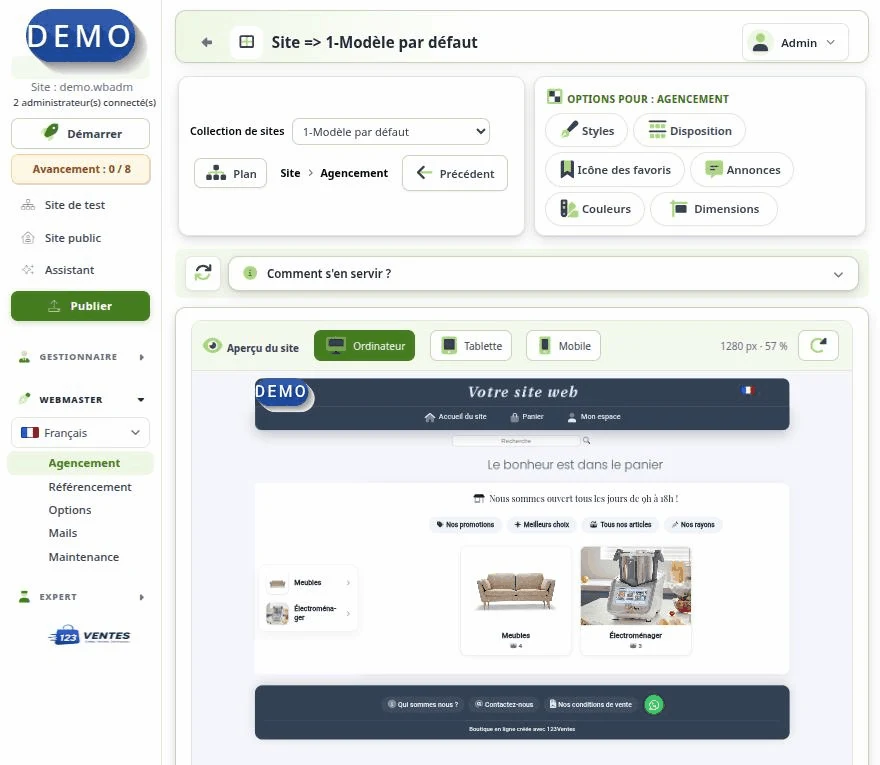
123Ventes was designed to pass these seven criteria. The price fits in one sentence: €29.90 a month, or €319.90 a year, with no commission on your sales. Hosting, the security certificate, card and PayPal payments, delivery methods, in-store pickup, statistics and the newsletter are all included. Your products are unlimited, and your shop can speak five languages: French, English, German, Spanish and Italian.
You edit everything yourself, directly on the page. And when you get stuck, you write to a real person, in Vence in the south of France, who knows your shop. If you would rather not set anything up at all, we can also build the shop for you, as an option.
The details are on our features page, and all the prices on the pricing page. And if your shop is already online but sells little, read why my website is not selling: the problem does not always come from the tool.
Conclusion
Choosing a simple e-commerce solution is not a lack of ambition. It is deciding that your time is worth more in the workshop than buried in a settings menu, that your margin should stay in your pocket, and that you want someone to talk to when things go wrong. The day your shop needs more, you will know. Until then, what it needs most is you.
👉 Try 123Ventes for free and judge for yourself.