How to succeed in e-commerce as a craftsperson or small shopkeeper
Published on , updated on 9 min read The 123Ventes team
You often read that all you need to do is open an online shop to sell “while you sleep”. In reality, while you sleep, the shop sleeps too. An online shop that works is first and foremost a small business: you need products people like, prices that leave a margin, parcels that arrive in one piece and an owner who answers questions.
The good news: you already know how to do all that in your workshop or your shop. To succeed in e-commerce, you do not need a special talent for computers, just method. Here is how to take your know-how online without losing your evenings to it: nine tips, the figures to keep an eye on and a plan for your first 90 days.
1. Know what you sell, and who to
“I sell jewellery” is not enough. There are millions of pieces of jewellery on the internet. “I handcraft silver jewellery inspired by the Mediterranean, made to be given as gifts”: now we are starting to understand why someone should buy from you rather than elsewhere.
Take five minutes to answer three questions in writing:
- what makes my products different (handmade, local, made to measure, a material, a story)?
- who buys them today, in the shop, at markets, over the phone?
- why do these people come back?
Your answers become the welcome line of your website, the tone of your product pages and the thread running through everything you publish afterwards.
2. Start small
There is no point putting your entire stock online on day one. Start with 10 to 20 products: your best sellers, with good photos and descriptions written by you. A small, well-kept shop sells better than a big, half-filled catalogue, and you will learn the trade without drowning.
You can add the rest over the following weeks. And every new product will be a good excuse to tell your customers about it.
3. Work out your margin, for real
This is the step everyone skips, and the one that closes the most shops. Online, a product costs more to sell than over the counter: there is the packaging, the payment fees, sometimes part of the postage, and the time spent preparing the parcel.
Example with a ceramic bowl sold for €35:
| Selling price | €35.00 |
| Clay, glaze, firing | − €7.00 |
| Box and packing paper | − €2.50 |
| Card payment fees | − €0.80 |
| Platform commission (if it takes one) | − ? |
| Left to pay for your time and overheads | €24.70 |
Out of that €24.70, you still have to pay your social security contributions, the hour at the potter’s wheel, the packing and the trip to the post office. If the result makes you wince, that is fine: now is the time to adjust the price, not after a hundred orders.
Beware of tools that take a percentage of every sale. 2% sounds like very little, but it is 2% of your turnover, not of your profit: on our bowl, that is €0.70 gone every single time.
4. Take care of shipping (and collection)
The parcel is the only part of your shop the customer actually touches. A bowl that arrives broken means a refund, a replacement and a customer who will not come back.
- Test your packaging: prepare a parcel and drop it from a height of one metre (for real). If it survives, it might just survive the courier.
- Show delivery charges early, on the product page if possible. Nobody likes discovering them at the checkout.
- Offer collection from the workshop or the shop: no delivery charges for the customer, and a chance to sell them something else.
- Slip in a handwritten note. It takes thirty seconds, and it is what the customer will talk about.
5. Get your paperwork right from the start
Selling online in France means distance selling, and a few rules apply. Nothing too daunting, but it is better to know them before the first order:
- legal notice: who you are, your SIRET number (the French business registration number), your contact details, your web host;
- terms and conditions of sale: prices, delivery, payment, guarantees;
- right of withdrawal: your private customers have 14 days to change their minds, with some exceptions (personalised or perishable products, for example);
- consumer mediator: you must name one, as it is compulsory in France for selling to private customers;
- personal data: explain what you do with your customers’ addresses, and do not sell them on.
It looks like a lot written down like that. In practice, it is a few pages to fill in once and for all, and a good shop solution prepares them for you.
6. Reply quickly, and like a human being
This is your greatest asset against the giants of online retail: you are a real person. A customer who asks a question and gets an answer the same day, signed with your first name, has almost already bought.
After each order, kindly ask for a review, on your Google Business Profile for example. Reviews reassure new customers far better than any promotion. And when a review is bad, reply calmly and offer a solution: readers mostly look at the reply.
7. Set yourself a time slot, and stick to it
An online shop is not a project you launch and then forget. Nor is it a second full-time job. For a craftsperson or shopkeeper, two to three well-organised hours a week are often enough:
- one hour to prepare orders and answer messages;
- one hour to add a product, change a photo or publish something new;
- a quarter of an hour to look at your figures: visits, orders, abandoned baskets.
Put this slot in your diary, like a customer appointment. If the tool asks much more of you just to keep running, you are not the problem, the tool is.
8. Be patient (yes, really)
A brand-new shop is invisible. Google takes several weeks, often several months, to get to know it and trust it. The first sales almost always come from your existing customers, the people around you and word of mouth.
Do not judge your shop on its first month, judge it on its first year. And in the meantime, help it along: tell your customers about it, put the address on your business cards and your bags, and follow our advice to attract customers online. If after a few months visitors come but do not buy, our article Why is my website not selling? will help you find out what is holding things up.
9. Track three figures, not thirty
Online shop dashboards display dozens of charts. For a craftsperson or shopkeeper, three figures are enough, checked once a week:
- The conversion rate: out of 100 visits, how many orders? For a small shop, 1 to 3% is a common result. With 400 visits a month and 2%, our €35 bowl makes 8 orders, or €280. Below 1% for several months, something is blocking: photos, prices, delivery charges or trust.
- The average order value: how much does a customer spend per order? Raising it is often easier than attracting new visitors: offer the bowl with the matching plate, give free delivery from €60, create a gift box.
- Returning customers: a happy customer who orders again is worth far more than a new visitor. If they never come back, look at the packaging, the delivery times and the little note in the parcel.
Write these three figures down every month in a notebook or a spreadsheet. After three months, you will know exactly where to focus your efforts.
Your plan for the first 90 days
To succeed in e-commerce, the hardest part is getting started and then keeping up the pace. Here is a simple plan, to adapt to your trade:
| When | What you do |
|---|---|
| Weeks 1 and 2 | Put 10 to 20 products online with good photos, fill in the legal pages, set up payment and delivery, then place a test order to yourself. |
| Weeks 3 and 4 | Announce the shop to your existing customers (email, social media, a small poster at the counter), add the address to your cards and your Google Business Profile. |
| Month 2 | Publish something new every week, ask for a review after each order, note down your three figures. |
| Month 3 | Adjust prices and delivery charges, highlight the products that sell, write a page or a tip about your craft to be found on Google. |
At the end of the third month, you will not have made your fortune yet, but you will have a shop that is up and running, your first reviews and figures to decide what comes next.
And what about the tool?
You will have noticed: we have talked about products, margins, parcels, customers and patience, but very little about technology. That is deliberate. The tool should let you get on with your trade, not become an extra job.
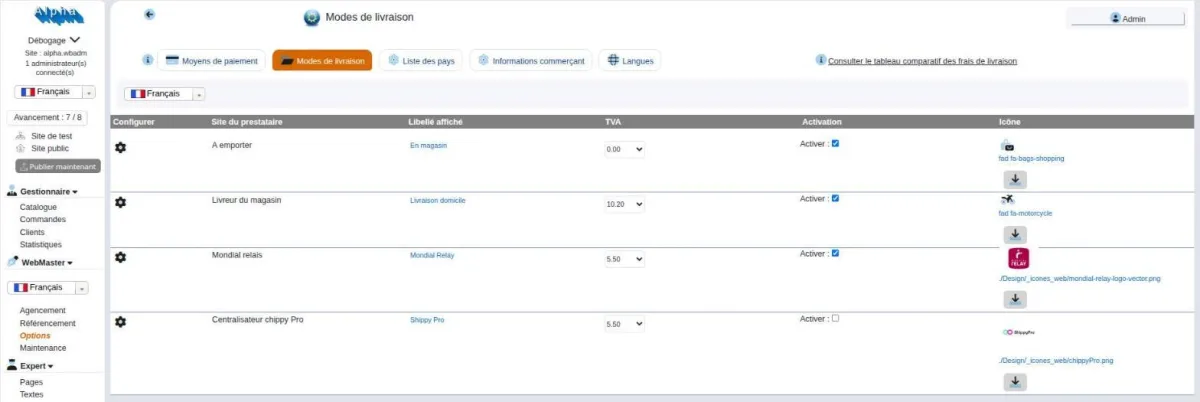
That is the idea behind 123Ventes: a shop ready to fill, with card payment, PayPal and bank transfer, delivery methods, in-store pickup, legal pages to complete, the domain name and hosting. €29.90 a month, or €319.90 a year, with no commission on your sales. Our €35 bowl earns you the same whether you sell one or a thousand. And if you get stuck, you write to a real person, in Vence in the south of France.
Above all, the subscription only starts with your first order. You build your shop, you test it, you show it to your customers without paying a penny: you only pay when you sell.
To prepare everything before you start, read our guide to an online shop for craftspeople.
To compare with other solutions: An alternative to Shopify, An alternative to Wix and the real price of an online shop.
Frequently asked questions
How do you succeed in e-commerce when you are just starting out?
Start small, with 10 to 20 well-presented products, work out your margin before setting your prices, take care of the packaging and reply to customers quickly. Announce the shop first to people who already know you, then give yourself at least a year and two to three hours a week to make it grow.
How long does it take to make your first online sales?
The first orders often arrive in the first few weeks, thanks to your existing customers and the people around you. Sales coming from Google take more patience: several months, the time it takes for the search engine to discover and rank your pages.
What conversion rate should a small online shop aim for?
For a small shop, 1 to 3 orders per 100 visits is a common result. If you stay below 1% for several months, check your photos, prices, delivery charges and the things that build trust: reviews, contact details, clear terms of sale.
What budget do you need to launch an online business?
For a small shop on a platform, allow a few hundred euros in the first year: the subscription, the domain name, packaging and perhaps a little advertising. At 123Ventes, the subscription is €319.90 a year or €29.90 a month, with no commission, and it only starts with your first order.
Do you need a business status to sell online?
Yes. In France, as soon as you sell regularly, you need a registered business. To get started, many craftspeople choose the micro-entreprise (a simplified sole-trader status), which is easy to set up. You must also display a legal notice and terms and conditions of sale, and name a consumer mediator.
To go further: creating an e-commerce website, the 3 ways to do it and the legal obligations for selling your creations online.
Conclusion
Succeeding in e-commerce is not a matter of technology or luck. It is a business like any other: good products, a fair price, well-packed parcels, quick replies, a little time each week and plenty of patience. You already have almost everything. All you are missing is the shop window.
👉 Try 123Ventes for free and open yours.